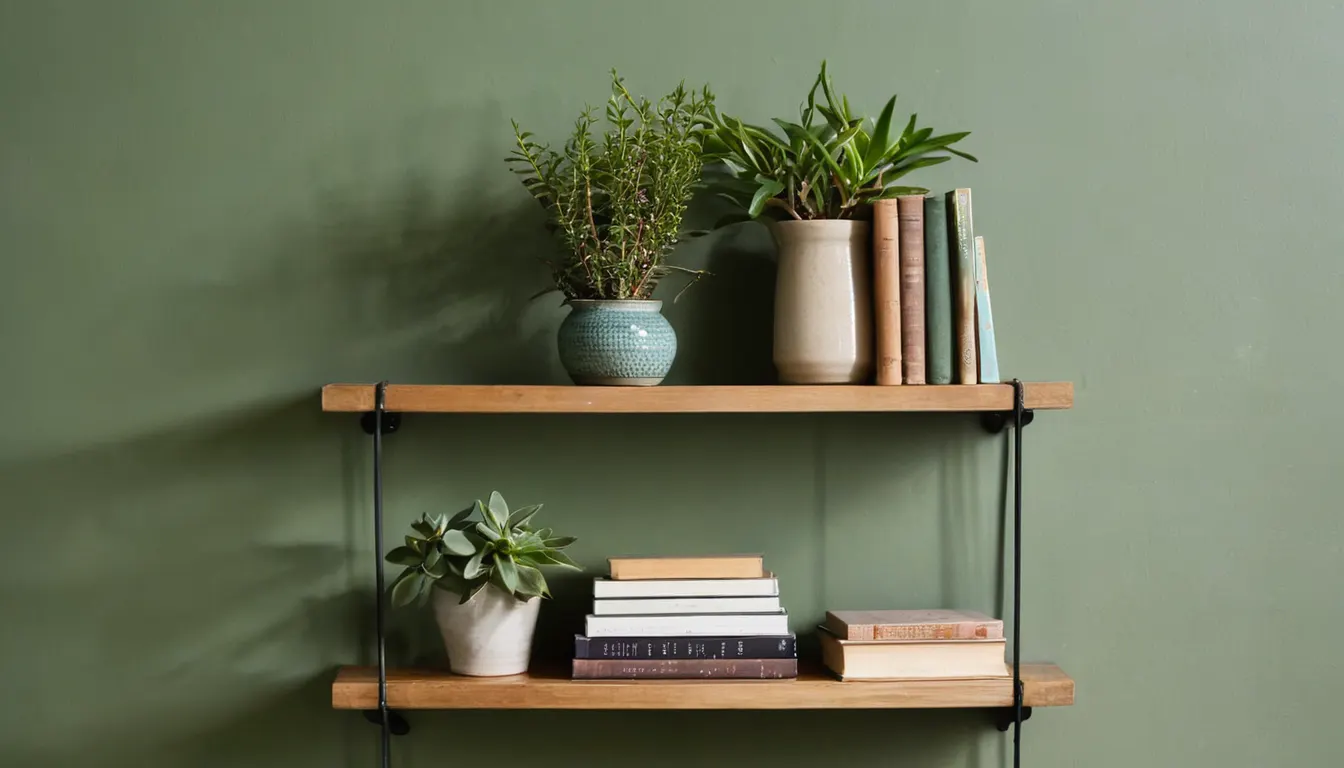
The core rules
Rule of odds
Group objects in threes or fives. Odd groups feel natural because the eye cannot split them into neat pairs.
Layer heights
Put one tall, one medium and one low object together. A triangle of heights looks balanced.
Negative space
Leave a third or more of each shelf empty. Space around an object is what lets you see it.
Repeat colour
Pick one or two colours and repeat them on several shelves so the eye moves across the whole unit.
A step-by-step method
- Empty it completely. Dust, and decide which things you love and which only fill space.
- Place the largest pieces first. Big vases, framed prints leaning at the back or stacks of large books. Stagger them in a zigzag from shelf to shelf rather than lining them up in a column.
- Add books. Mix upright rows with horizontal stacks. A horizontal stack makes a natural plinth for a small object.
- Add medium objects in groups of three, overlapping slightly front to back.
- Add something living or natural: a plant, a branch in a bottle, a bowl of stones or shells.
- Step back. Squint at the unit from across the room and take away the one thing that looks busiest.
Arranging books
- By colour looks striking but can make books hard to find; try it on one shelf only.
- By size gives a tidy, library look.
- Turning spines inward hides titles and is hard to live with; most people prefer not to.
- Bookends, or a heavy object at the end of a row, stop leaning and add interest.
Mix materials
Balance hard and soft, shiny and matte, smooth and rough: a glazed vase beside a wooden bowl, a woven basket under a glass bottle. If every object is the same material, add one that contrasts. If the shelf already feels busy, remove patterned items first and keep plain ones.
Idea boards
Neutral display
Stone and oak
Ivory wall · Stone ceramics · Grey-green · Dark oak
- Unglazed ceramics in three sizes.
- Two stacks of books, spines facing out.
- One small dark wooden object to anchor each shelf.
Painted back
Sage backdrop
Sage back panel · Cream ceramics · Brass · Black frames
- Paint or line the back of a bookcase so pale objects stand out.
- Leaning black-framed prints at the back of two shelves.
- A single brass candleholder repeated low and high.
Beyond shelves
The same rules work on a mantel, a sideboard or a windowsill. On a long surface, anchor one end with the tallest piece, build down towards the middle and leave the other end lighter. For a coffee table, a tray gathers small things into one shape. For colour choices, see the colour guide.